By Sienna Walsh · Last updated 17 May 2026
Table of Contents
Toggle“Pitbull” is one of the most-misused words in dogdom. It’s not technically a breed. It’s a catch-all the media uses for several distinct breeds and a lot of mixes. If you’ve ever tried to explain to a relative that a Staffy is not the same as an American Bully, you’ll know how confused the whole space is.
This pillar separates the actual breeds, the colour-based marketing terms (blue nose, red nose), and the legal status in Australia, the UK, and the US. If you’re considering one as a family dog, the last section is the one to read.
The actual breeds
American Pit Bull Terrier (APBT)
- Size: 14-20kg, 43-53cm at shoulder
- Coat: short, single layer, smooth
- Temperament: energetic, affectionate with people, drive-focused
- Recognised by: UKC, ADBA — not AKC
- Best for: active homes with adult supervision, structured training
The “original” pitbull — bred in 19th-century England as a working farm dog and bull-baiter, then refined in the US. Generally robust, athletic, sensitive to handler emotion. Despite the media reputation, in well-bred and properly-socialised lines the APBT is famously gentle with its people. Aggression problems usually trace to inadequate socialisation, isolation, or backyard breeding.
American Staffordshire Terrier (AmStaff)
- Size: 18-30kg, 43-48cm
- Coat: short, smooth
- Recognised by: AKC, FCI
- Best for: active homes, calm handling
Essentially the AKC-recognised version of what split off from the APBT line in the early 1900s. Slightly stockier, slightly less drive on average. AmStaffs are show-bred with conformation standards while APBTs were working-bred. The two have been considered the same breed by some registries and different by others — confusing, but the practical reality is they’re closely related.
Staffordshire Bull Terrier (“Staffy”)
- Size: 11-17kg, 36-41cm — significantly smaller than APBT/AmStaff
- Coat: short, smooth
- Recognised by: Kennel Club (UK), AKC, FCI
- Best for: family homes — known historically in the UK as “the nanny dog”
British breed, smaller and stockier. Famous in the UK as one of the most popular family dogs, with a strong reputation for gentleness with children when raised properly. Higher energy than people expect for the size. Very affectionate, sometimes too clingy.
American Bully
- Size: Pocket (35-43cm), Standard (43-51cm), Classic, XL (51-58cm), XXL
- Coat: short, smooth
- Recognised by: ABKC (American Bully Kennel Club)
- Best for: stable adult homes with significant outdoor space
Modern breed, deliberately bred from APBT/AmStaff foundation stock plus other bully breeds (English Bulldog, Olde English Bulldogge) for a heavier, broader, calmer companion. Five recognised size categories. Famous for the “blocky” head and exaggerated chest. Generally lower drive than APBTs. XL Bullies are the variety currently banned in the UK (see below).
“Blue Nose” and “Red Nose” — not breeds
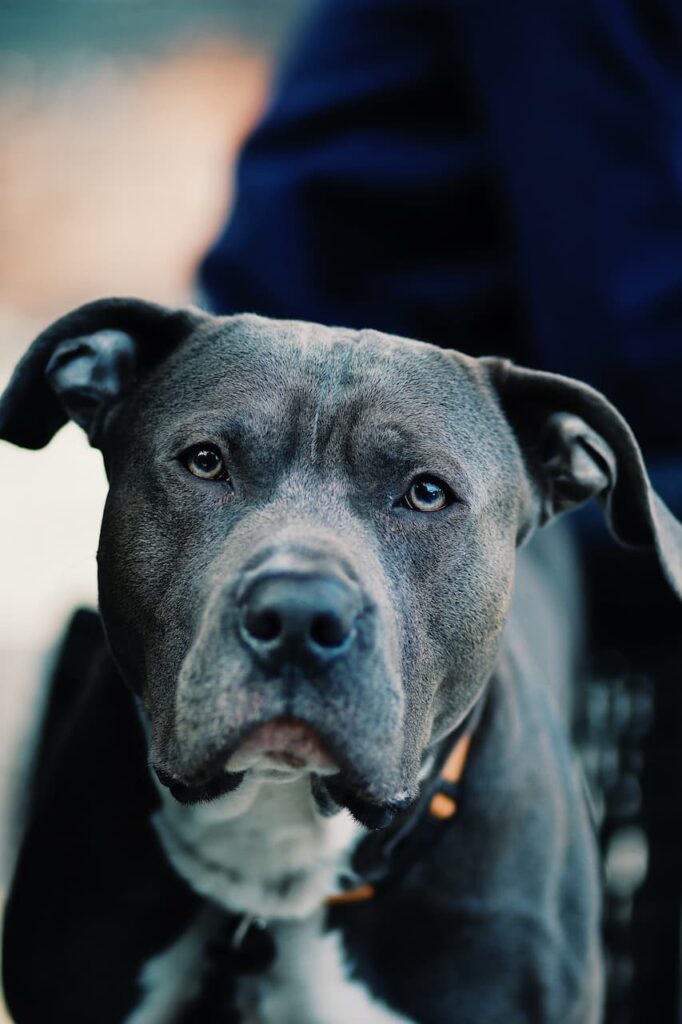
These are colour descriptors, not breeds. A “blue nose pitbull” is an APBT, AmStaff, or AmBully with a recessive grey/blue pigmentation in the nose, eye rims, and coat. A “red nose” is the same dog with a reddish-brown pigmentation. Both come from older bloodlines (the OFRN — Old Family Red Nose — has 19th-century Irish roots).
Backyard breeders charge a premium for “blue nose” puppies. There is no special breed quality — it’s just colour. Don’t pay more for it. Our existing post on the blue nose pitbull goes into more detail on the genetics.
Quick comparison
| Breed | Size | Energy | Best for | Banned in UK |
|---|---|---|---|---|
| APBT | 14-20kg | High | Active home, training-focused | Yes (DDA 1991) |
| AmStaff | 18-30kg | High | Active home, training-focused | No (registered AKC) |
| Staffy | 11-17kg | High | Family with kids | No |
| American Bully (Standard) | 20-32kg | Medium | Adult home, calm handling | XL variety yes |
| “Blue/Red Nose” | (varies — colour) | (varies) | (varies by underlying breed) | (varies) |
Legality (a moving target)
United Kingdom
The Dangerous Dogs Act 1991 bans (or restricts ownership of) several “types”:
- Pit Bull Terrier
- Japanese Tosa
- Dogo Argentino
- Fila Brasileiro
- XL Bully (added in 2024)
“Type” is judged on physical characteristics, not pedigree. A dog with no APBT in its parentage can still be classified as “pit bull type” by a court. Owners of “type” dogs need an Index of Exempted Dogs certificate, neutering, microchipping, third-party insurance, and muzzling in public.
Australia
Restricted-breed status applies to APBT in most states under federal law (cannot be imported, must be desexed). State-specific rules vary considerably — Queensland and NSW have stricter declared-dog regimes than Victoria, for instance. American Bullies are not currently restricted federally but check your state.
United States
No federal restrictions. State and city laws vary wildly. Some cities ban “pit-bull-type” dogs outright (BSL — Breed Specific Legislation); others ban only specific breeds; many have no restrictions. Insurance companies and landlords often impose their own restrictions regardless of municipal law.
Are they good family dogs?
Honest answer: the well-bred, well-socialised individual is one of the best family dogs around. The poorly-bred, under-socialised, “guard dog raised in the back yard” individual is dangerous. The breed-aggression statistics are skewed by both of those realities and by media-reporting selection.
What we’d actually look for if you’re choosing one as a family pet:
- Adopt from a reputable rescue with adult-temperament-tested dogs. Skip Gumtree and “backyard” sellers.
- Meet the parents if you’re going to a breeder. Walk away if either is twitchy or unhandleable.
- Start training before you bring the dog home — schedule a puppy class.
- Socialisation during the 8-16 week window is the single biggest determinant of adult behaviour. Don’t skimp.
- Crate-train. They are happier with their own quiet space.
- Daily exercise plus mental work. A bored, under-exercised bully-type is a destructive bully-type.
- Always supervise with very young children — true of any 20kg dog regardless of breed.
Common health issues
- Hip dysplasia — Bullies and AmStaffs more than Staffies
- Skin allergies — common, often manageable with diet
- Cardiomyopathy — particularly American Bullies
- Cherry eye, entropion — Bullies
- Ear infections — short coat, exposed ears, water trapping
- Cruciate ligament tears — high-energy, robust dogs are prone
Annual vet check, weight management, joint supplements from 5+, and dental cleaning are the usual long-term care commitments.
Further reading
- The Kennel Club — UK breed standards
- American Kennel Club — US standards and breed pages
- Our existing posts on the Blue Nose Pitbull and Cavapoo as comparison breeds
We get asked — dog FAQ
What human foods are toxic to dogs?
The non-negotiable list: chocolate, xylitol (a sweetener in sugar-free gum and some peanut butters), grapes and raisins, macadamia nuts, onion and garlic family, alcohol, caffeine, and raw bread dough. Xylitol is the single most dangerous common household item — it causes catastrophic hypoglycaemia in tiny doses. Full safe-and-toxic list in our food master list.
When should I take my dog to a vet for “something they ate”?
Any of the toxic list above, in any amount. Or any food in larger-than-treat amounts paired with vomiting, lethargy, weakness, tremors, or seizures. The Animal Poisons Helpline (1300 869 738 in Australia, 01202 509000 in the UK, 1-888-426-4435 in the US) can triage. Have the packet of whatever they ate handy.
Related reading
Page last updated 17 May 2026. We re-check our pet-care content regularly and update when something changes.