By Lachlan Ortega · Last updated 17 May 2026
Table of Contents
ToggleBonding has two meanings in guinea pig land: bonding with your pigs (taming them so they trust people), and bonding pigs to each other (introducing a new pig so they live together happily). This pillar covers both, because they hit new owners at the same time.
Part 1 — Taming a guinea pig
Guinea pigs are prey animals. Their hardwired response to anything approaching from above is freeze, then flee. New pigs hide for the first two-to-six weeks, sometimes longer. That’s normal. Your job is to be boring, predictable, and food-bearing.
Week 1 — sit and exist
Sit beside the cage daily. Read a book, watch your phone, talk quietly. Don’t reach in. The pigs need to learn that “human shape near cage” doesn’t equal “predator”. Do this twice a day for 10-15 minutes minimum.
Week 2 — bribery through bars
Hand-hold a piece of bell pepper or cucumber through the bars. Hold still. Wait. The first time they take it might be 10 minutes in. Each day they’ll take it faster. After a few days they’ll start running over when they see you coming.
Week 3 — hand inside the cage
Open the cage door. Lay your hand flat on the floor, palm up, with a piece of veg in it. Wait. They’ll come and eat from your hand. Don’t move your other hand. Don’t try to pick up. Several days of this.
Week 4+ — short lap time
Once they take food from your hand reliably, scoop one up (technique below) and sit with them on the floor in a contained space, with a towel on your lap. Five minutes first time. Build to 20-30 minutes a day.
Don’t hold them up high, don’t pass them around, don’t let other pets near, and definitely don’t let well-meaning friends shove their faces into the pig’s face. Trust takes weeks to build and minutes to lose.
How to actually pick up a guinea pig
The single most common mistake new owners make is grabbing around the middle. Guinea pigs are barrel-shaped — squeeze them and their ribs flex and it hurts. They learn that “human hand approaching” means “pain incoming” and you’ve just undone two weeks of bonding.
The technique:
- Approach from the side, not above.
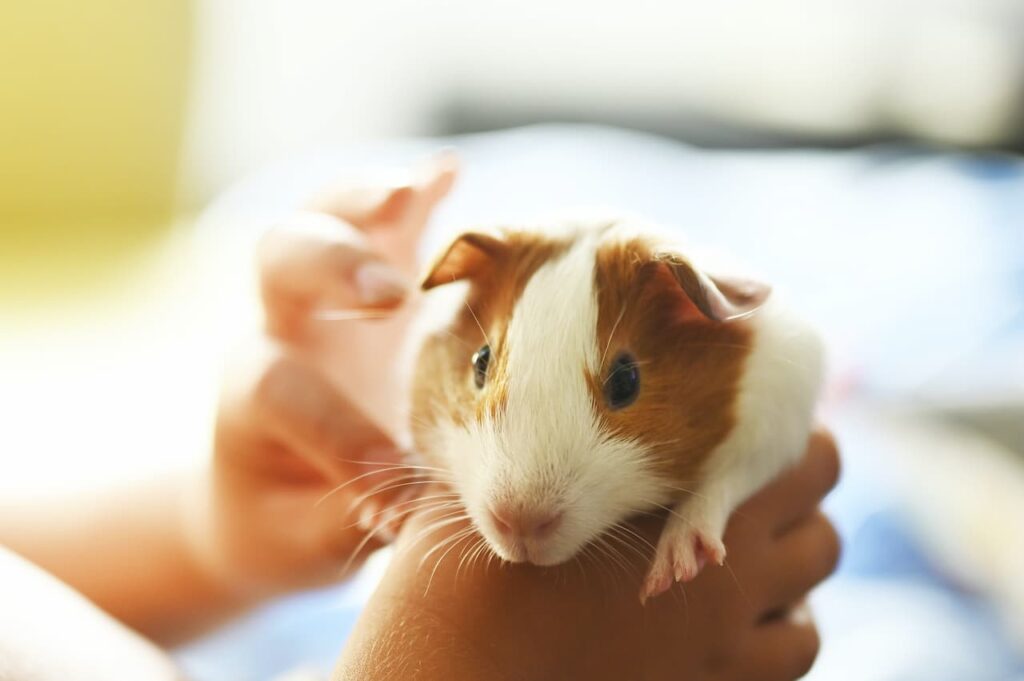
- Slide one hand under the chest, fingers cupping under the front legs.
- Bring the other hand under the rear, supporting the back legs and bum.
- Lift slowly. Hold close to your body so they feel secure.
- To put down: lower bum-first to the floor of the cage, then release the chest hand.
Always lift bum-first into a tunnel or hide first if they’re flighty — once they’re in a familiar enclosed space they relax and the next scoop is easier.
Lap time done right
- Sit on the floor or a sofa with a towel across your lap (they will pee — accept this)
- Keep one hand resting gently on their back so they don’t try to leap
- Have a small piece of veg ready as a reward
- Quiet voice, no sudden movements
- 5-10 minutes for the first few sessions, building up
- Always pick them up from lap and return them to the cage — don’t let them jump
Some pigs love it within a week. Some pigs tolerate it after six months. Both are normal. Don’t compare your pig to a YouTube pig.
Reading guinea pig body language
| What you see | What it means |
|---|---|
| “Wheek” (high-pitched scream) | Food, please. Now. |
| Purring / vibrating (low, steady) | Contented |
| Purring (higher, choppy) | Annoyed — they want to be put down |
| Rumblestrutting (low rumble + swagger) | Dominance or mating display |
| Teeth chatter | “Back off” — usually between pigs |
| Popcorning (sudden jumps) | Happy. Bottling sunshine. |
| Freezing flat | Scared — give space |
| Head toss | “Stop touching me there” |
| Yawn with full teeth display | Threat — between two boars usually |
Part 2 — Bonding two pigs together
Guinea pigs need company of their own kind. A solo pig is a stressed pig, and most welfare organisations now consider solo housing a welfare issue. If you’ve ended up with a solo pig (your other one passed, you bought a single, etc.), please bond a friend.
Pairings that work
- Two desexed males (boars)
- Two or more females (sows)
- A desexed male with one or more females
- An older boar with a young boar (older usually accepts)
Pairings that often don’t work
- Two intact adult boars meeting for the first time after 8-10 months old
- Boar-boar trio (the odd one out gets picked on)
- Any pairing where one pig has a recent injury or illness — wait until they’re well
The bonding session
The most important rule is neutral territory. Pigs are territorial about their home cage; meeting in the cage is a recipe for blood. Use a playpen in a room neither pig has been in (the bathroom is great), or your kitchen floor.
- Cover the floor with a towel and lots of hay (so they immediately have something to do)
- Two hides minimum, both with two openings so neither pig gets cornered
- One veg pile — they need to learn to share
- Stay nearby for at least the first hour
- Have a heavy towel or dustpan ready to separate them if needed (never use bare hands in a fight)
Normal “introduction” behaviour
- Rumblestrutting (the swagger walk with a low rumble)
- Mounting (both males and females do this — it’s dominance, not sex)
- Teeth chattering
- Some chasing
- Hair lifting along the back
- Brief lunging without contact
Stop the bond and try again later if:
- Either pig draws blood
- They lock together in a rolling ball
- One pig is being relentlessly chased and is now hiding constantly
- You hear loud screaming followed by sustained aggression
Plan A for “didn’t take”: separate, wait 2-3 weeks, try again in a different neutral space. Plan B: try a different partner. Some pigs just don’t click, like people.
After a successful intro
- Bonding session 2-4 hours. End on a good note.
- Move them together into a deep-cleaned cage (so neither’s smell is dominant), with new hides and rearranged layout
- Watch for the first 48 hours but don’t intervene unless real fighting starts
- It takes 2-3 weeks for them to fully settle into hierarchy
Bonding with kids in the house
Guinea pigs are good kid pets if the child is old enough to understand the rules and supervised by an adult. Practical guidelines from our team:
- Under 6 — kids don’t handle the pig, but can sit beside them, feed them through the bars, and talk to them
- 6-10 — short supervised lap time on the floor only
- 10+ — can do most of the daily care with adult oversight
- The adult takes vet responsibility regardless of age
Further reading
- RSPCA UK — Guinea pig companionship
- Australian Veterinary Association — guinea pig welfare standards
- Our complete care guide covers diet, housing, and vet basics
- Wheek vocab in depth in our “calm down a stressed small pet” series
We get asked — guinea pig food FAQ
How much fresh veg should a guinea pig eat per day?
About 1 cup of fresh vegetables per pig per day, ideally split into two meals (morning and evening). Hay should still be 80% of the diet and available unlimited. Pellets are a small daily addition, not a meal replacement.
What’s the most important nutrient for guinea pigs?
Vitamin C. Guinea pigs cannot manufacture their own and must get it daily from fresh food. Bell pepper is the gold-standard source. Vitamin C in pellets oxidises within weeks of opening, so don’t rely on pellets alone. See our food safety master list for daily portion guidance.
What signs should send me to a vet?
- Not eating for 12+ hours (GI stasis — emergency)
- Not pooping (or smaller, drier poops than usual)
- Crusty eyes, wheezing, or sneezing more than once a day (URI)
- Hunched posture, fluffed coat, hiding
- Sudden weight loss (weigh weekly to catch this early)
- Blood in urine, hunching when peeing
A pig that hasn’t eaten in 12 hours is an emergency, not a “wait and see” situation. More detail in our vet warning signs pillar.
Related reading
- The complete guinea pig care guide — diet, housing, social pairs, lifespan
- Master food safety table
- Cage setup & size guide — most pet-shop cages are too small
- RSPCA UK — Guinea pig welfare standards
Page last updated 17 May 2026. We re-check our pet-care content regularly and update when something changes.